1750-1850
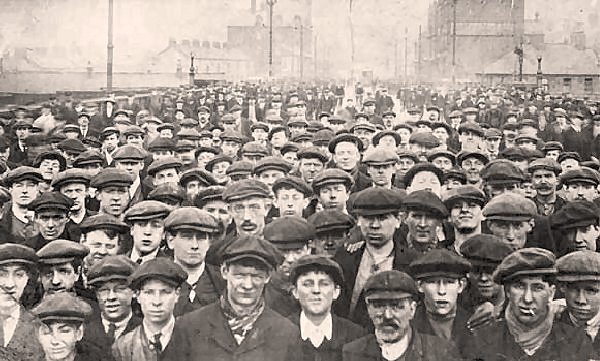 | The Industrial RevolutionThe Industrial Revolution was a movement in agriculture, technology, manufacturing, transportation, and mining. It began in Brittan, and slowly made its way to America. Many people were moving from farms to cities, looking to work in the large factories that were being built all around.
Left: Hundreds of men and childern lining up to recieve a job at the dirty factories.
|
What Was The Industrial Revolution?
Industrial Revolution: N. The totality of the changes in economic and social orginization that began about 1760 in England and later in other countries, characterized chiefly by the replacement of hand tools with power-driven machines, as the power loom and the steam engine, and by the concentration of industry in large establishments; the transformation in the 18th and 19th centuries of first Britain and then other W European countries and the US into industrial nations; The rapid industrial growth that began in England during the middle of the eighteenth century and then spread over the next 50 years to many other countries, including the United States. The revolution depended on devices such as the steam engine, which were invented at a rapidly increasing rate during the period. The Industrial Revolution brought on a rapid concentration of people in cities and changed the nature of work for many people.
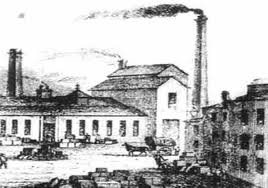
Above: Many factories were being built in towns when the Industrial Revolution hit America. Many people were moving to cities to work in these crowded, damp buildings for little pay every day. They got by with just enough to support their families.
Many new machines were being thought of and produced as improvements in factories and farming were needed. Many inventors produced new machines and tools, which were used frequently throughout the Industrial Revolution.
|
Inventor |
Invention |
Function of Invention
|
Industry |
|
Jethro Tull |
Seed Drill; Horse drawn Hoe |
Planted deeds in straight lines; earths ground in straight lines, easier to make rows. |
Agriculture |
|
Eli Whitney |
Cotton Gin |
Cleaned cotton on plantations faster and more efficiently. |
Agriculture |
|
James Watt |
Steam Engine |
Produced trains that used steam instead of water to produce more power, and go faster. |
Transportation |
|
Samuel Morse |
The Morse Code; Telegraph |
Used clicks and dashes changed into letters used for communication; transported the clicks and dashes. |
Communication |
|
Richard Arkwright |
Power loom |
Drove the Water Jenny by water power to be quicker. |
Textile |
|
Henry Bessemer |
Bessemer Process |
Found a cheaper way to produce steel. |
Steel/Iron |
|
Robert Fulton |
The Steam Boat |
Found a faster way of transportation using steam for a boat |
Transportation |
